My wife and I each have a sensory hobby and mine is coffee.
I switched from whiskey to coffee when I had a kid. Hangovers in your thirties are real and there’s no snooze button when someone small, persistent, and fierce bursts into your bedroom every morning at dawn demanding milk.
Los Angeles has some of the best coffee shops in the world — Ondo, Endorffeine, Maru Espresso Bar, and Mandarin are some of my favorites — but I live out in the burbs now so I switched to making high-end coffee at home.
Goals for 2025
My main goal for 2025 was to learn how to get the most out of what I spend on coffee.
Whiskey is much more expensive than coffee so I had a lot of headroom to explore, but more expensive doesn’t mean I would enjoy it more.
Two things I wanted to figure out:
-
The regions and producers I like best. Coffee has a huge range of flavor profiles that can vary wildly within a single region and it’s also seasonal.
Learning what regions I liked the most would help me figure out when to buy and when to hold off until the stuff I really enjoy comes around.
-
My personal point of diminishing returns. There are some extraordinarily expensive coffees. The most desired coffees come from Panama, sell at auction for $1000s per pound, and can cost $100s of dollars for a single cup when roasted.
You can buy 30g of this Best of Panama lot roasted by Hydrangea for ~$160 per cup, and that’s still ~10x cheaper than the most expensive coffee from this year.
I’m not balling like that, but I wanted to spend more this year and find out where I stopped enjoying the coffee more.
What I Bought
Here’s what I bought this year:
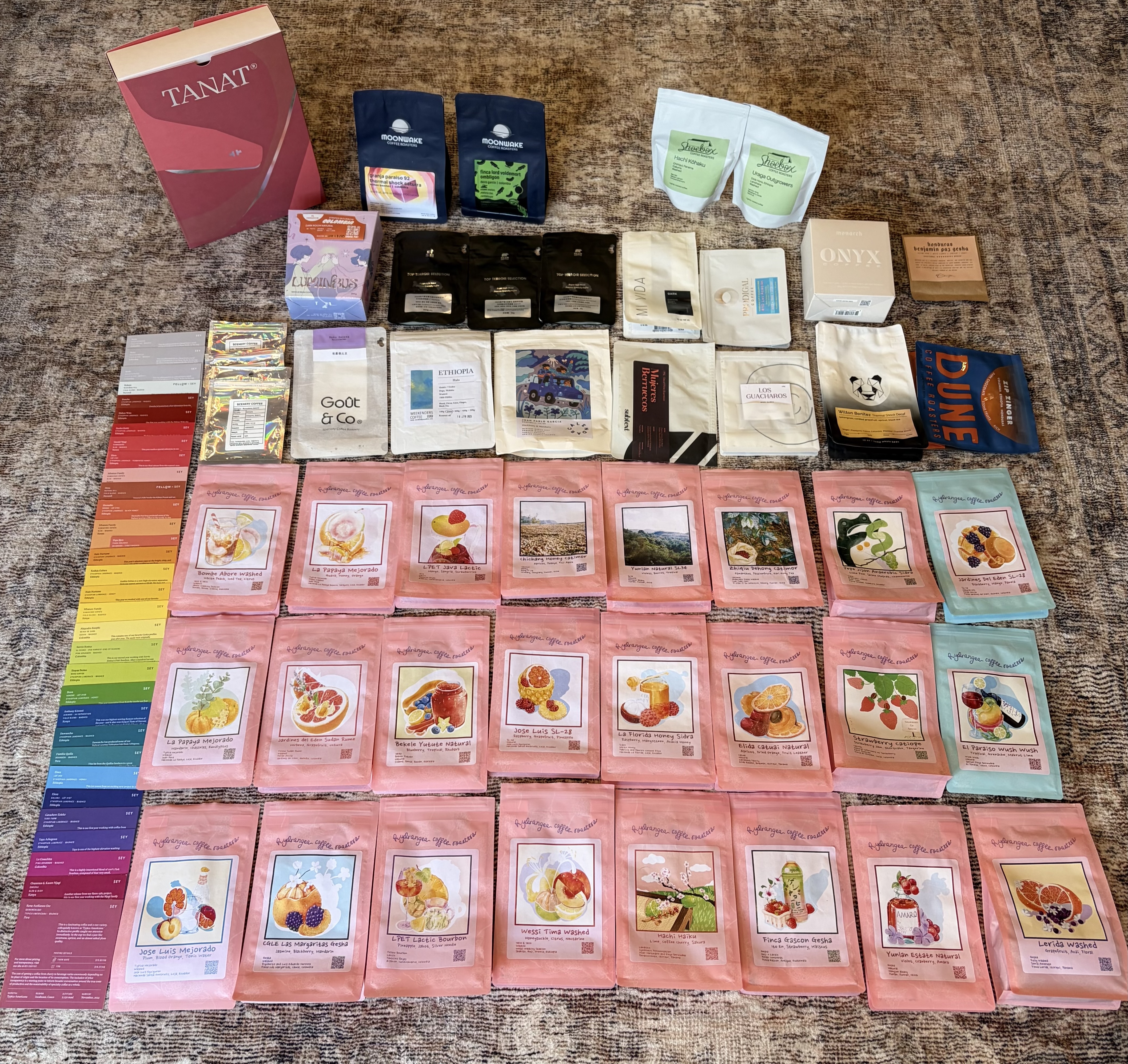
The coffee table couldn't even handle all this, I had to move them to the rug.
I have two main subscriptions:
SEY is out of Brooklyn. They’re focused on representing “terroir” — the unique flavor of a particular region. Almost everything they source is washed, and they’re specifically focused on finding and roasting coffees that show what makes a region unique. I like their coffee a lot and bought a lot of add-ons this year to explore more of a whole bunch of regions.
Hydrangea is out of Berkeley. They do lightly roasted, fruit-forward coffee—which is just what I like. Bill and the team are great at highlighting interesting processing methods and fruity washed coffees. I’ve had a subscription for years, and I love basically every bag regardless of origin.
I also splurged on a few expensive coffees this year and bought a bunch of Panama Geishas from Big Sur Coffee. I was planning on buying some Hacienda La Esmeralda and Gesha Village from some European roasters that I like (The Picky Chemist or Substance) but the uncertainty with tariffs made me hesitate and I held off.
Since I missed out on those high-end coffees earlier in the year, I decided to buy Tanat’s advent calendar.
What I Learned
I do like high-end coffee, but I don’t get more enjoyment out of it.
My sweet spot is somewhere in the $25-45 range for 250 grams. That is expensive compared to Folgers, but it’s still in the typical range for specialty coffee. Above that, the coffee still does get objectively better, but I don’t enjoy it any more.
The Panama Geishas I had this year were fantastic and you can’t get coffees like that anywhere else, but they weren’t in my top 5 coffees of the year and I didn’t necessarily enjoy them more despite being 3x more expensive.
Dialing in my region and producer preferences.
I still have a lot to explore here.
Right now I know I like Ethiopian coffees a ton. I enjoy a reasonably priced Ethiopian coffee as much as a high-end Colombian coffee that’s twice the price.
I also am probably not going to buy any extra Burundi or Peruvian coffees in 2026. I tried 3 bags from Burundi and 3 from Peru this year. I’ll happily drink them if they come through my subscriptions, but I’m not going to FOMO buy them if they’re not in season.
I’m not a big fan of advent calendars.
This was my second year doing a coffee advent calendar and I’m realizing the format isn’t for me.
I did the Onyx calendar in 2024 and the production quality is incredible and you get ~60g of coffee per day, but it was too much coffee for me to go through each day. This year I tried Tanat’s calendar and the coffee was great, all very high-end, but it was only 14 grams per day and one small cup isn’t enough time to really experience a coffee.
I’m thinking next year I’ll do a DIY advent—grab a few excellent bags through the year, freeze them, and enjoy one per week in December.
My Top 5 Coffees
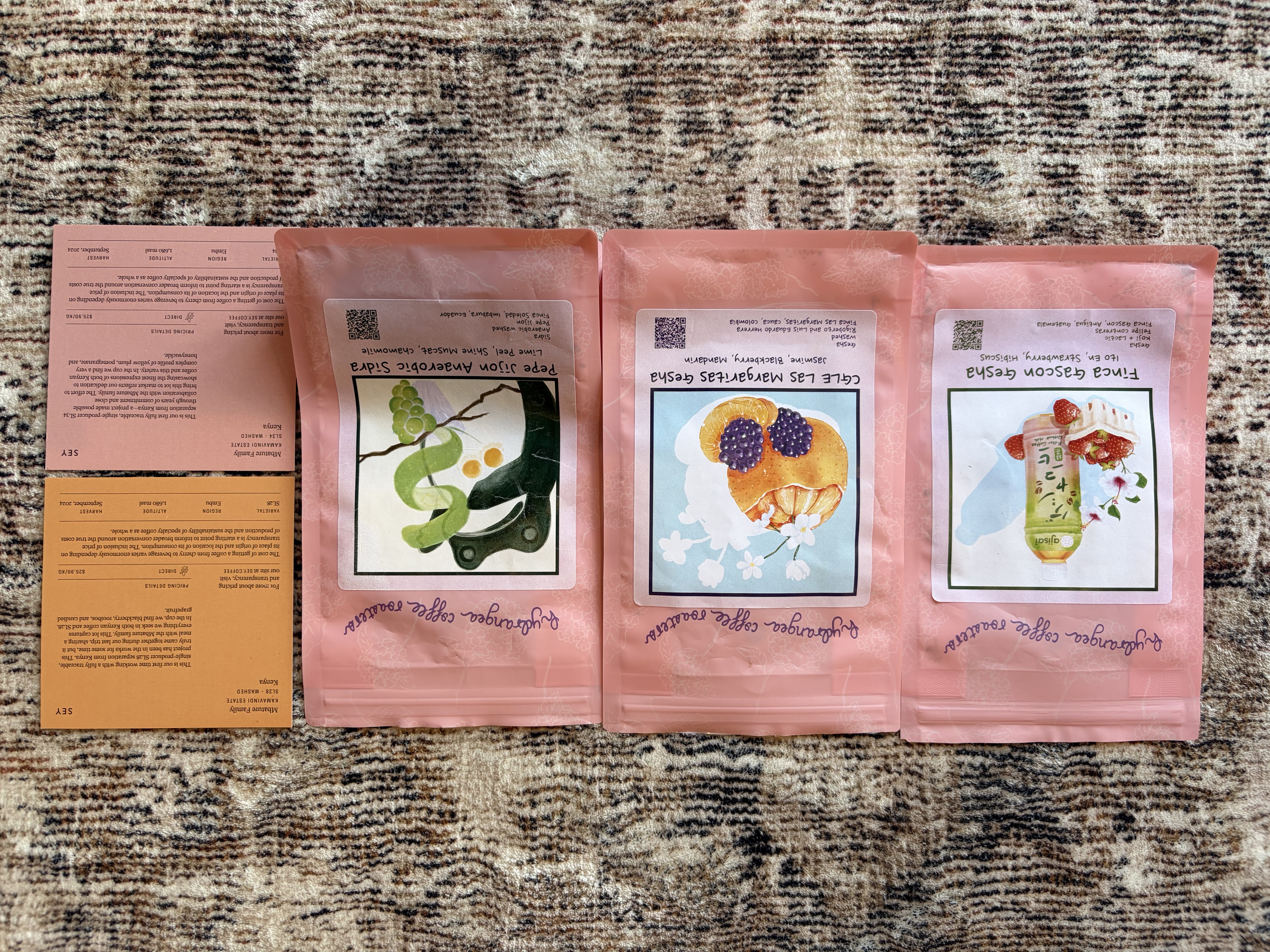
The real good stuff.
From Hydrangea:
Cafe Granja La Esperanza Las Margaritas Gesha — Maybe my favorite individual coffee of the year. It’s everything I like in coffee. It’s super rare to have a washed coffee that’s just… really juicy. The main body is like biting into a blackberry and the acidity and sweetness are like biting into a ripe mandarin, with a touch of jasmine that didn’t overpower (sometimes coffees with jasmine are all floral). This was like drinking juice.
Pepe Jijon Anaerobic Sidra — Green grape sweetness with a hibiscus-like acidity — not sharp, just a bit of that pleasant drying sensation from hibiscus tea. As it cooled, strong chamomile came through. Chamomile is a very rare note in coffee and I’ve never had chamomile come through in a coffee like this before.
Finca Gascon Gesha — Totally different than anything I’ve tried. The coffee cherries were fermented with koji (the same fermentation used to make miso and soy sauce) which I have never heard of before. The whole thing turned into a low-acidity strawberry green tea—like an Ito En bottled green tea but with a strawberry note. I’ve never had anything like it.
From SEY:
Mbature SL-34 and Mbature SL-28
SEY did a project with the Mbature family where they sourced an SL-34 and SL-28 as totally isolated, single origin coffees. Most Kenyan coffees are blends of 3-4 different varietals, often combined from several regions. Single producer coffees are rare. Getting two different varietals isolated from the same producer is basically unheard of. This is the first time SEY has ever done this and I’ve never heard of anyone else doing a release like this.
Having two coffees from the same producer and same farm, but isolated into different varietals and being able to taste and compare them side by side was one of the best coffee experiences of my year. The tasting notes from SEY are accurate — they taste very different even though they’re from the same place.
At $28 a bag, this was more memorable than the very expensive stuff, more educational, and just plain cool for a coffee nerd. The fact that this cost a fraction of the price of the most expensive coffee I bought this year really highlighted that price and enjoyment aren’t correlated for me.
An Unexpected Gift
The third thing I got from coffee this year wasn’t planned.
We moved to a new neighborhood at the beginning of 2025 and my daughter started preschool in the neighborhood. We met other families, I got to know a bunch of dads in the neighborhood, and we started getting together to have coffee when it works with the schedule.1
It’s become a little ritual. Someone texts the group, I pull some shots, we hang out in the kitchen for an hour. It’s not fancy. But having a hobby that gives you something to share and creates a reason to get together with friends has been a gift.
All in all, a pretty good year for friends and for coffee.
Footnotes
-
If any of our bosses are reading this don’t worry, these coffee hangs are definitely only on weekends and absolutely not why there are random “Busy” blocks on the calendar on weekday mornings. ↩